Welcome to the Impact Open 2026.
This year is a special occasion for Taekwon-Do Impact as we celebrate 30 years of Impact. Over the past three decades, Impact has grown through dedication, high standards, technical development, competition, discipline and community. The Impact Open is an opportunity to bring together competitors, coaches, instructors, umpires, parents and spectators for a full day of ITF Taekwon-Do competition.
Whether this is your first competition or you are an experienced competitor, our aim is to provide a fair, organised and enjoyable event where every student has the opportunity to test themselves, gain experience and represent their club with pride.
Thank you to all competitors, instructors, coaches, umpires, volunteers, parents and spectators for supporting the Impact Open 2026 and for helping us celebrate 30 years of Taekwon-Do Impact.

This year also gives us the opportunity to recognise a proud moment within Impact: the recent promotion of Grand Master Kim Anderson to IX Degree. Grand Master Anderson has made a significant contribution to Taekwon-Do through his teaching, technical knowledge, umpiring, event support and long-standing service to the art. We are pleased to acknowledge his achievement as part of this year’s Impact Open and to celebrate his continued role within the Impact family.
This programme is designed for competitors, parents, coaches and spectators.
It explains how the event works, how to follow the competition, what competitors need, how scoring works, where to get help, and what to expect during the day.
The most important live event information will be shown on Sportdata. This includes draws, ring numbers, category progress, results and live updates.
Please check Sportdata regularly throughout the day. Ring numbers and timings may change as the competition progresses.
Use this section for the main links people will need on the day.
All competitors must get registered before competing. If you have registered online, you simply need to check-in and get your wristband.
Online registration is mandatory for all Black Belt competitors.
Black Belts must complete their registration online before the event; there will be no on-the-day registrations.
Black Belt competition starts at 9:00am, so all Black Belt competitors must arrive early, be ready to compete, and check Sportdata for their ring and category information.
Online registration is optional for Colour Belt competitors.
Colour Belt competitors may register online in advance, or they may register in person on the day.
On-the-day Colour Belt registration will take place in the second hall as competitors enter the venue.
Please follow the guided route to the registration area. Once registered, competitors will be given a wristband. This wristband will be used to identify competitors throughout the event and allow them onto the mats.
Colour-belt competitors that are competing that have not done their weight or height checks online can do it on the day. Please see the timetable to know what time to arrive and when the deadline for the checks are on the day.
Please make sure your details are correct before the event, including your name, age, grade, height, weight and entered categories.
If your height or weight is different from what was originally entered, or if you need to be added to an additional category such as Patterns, a £15 surcharge will apply to adjust your entry details.
Changes are subject to approval by the event team and may not always be possible once divisions have been finalised.
Once registration is complete, and competitors have their wristband, they may enter the main hall.
Please then check Sportdata, find your ring, stay close to your coach or instructor, and be ready when your division is called.
Spectators may enter the hall when doors open at 9:00am.
A £5 spectator fee is payable on entry by cash or card. Once paid, spectators will receive a wristband. This wristband allows entry and re-entry throughout the day.
Please do not remove your wristband. If your wristband is removed, lost or damaged, you may be charged again on re-entry.
Please note that there may be internet issues inside the sports hall, which may affect card payments. Where possible, please carry cash as a back-up to avoid delays at the entrance.
Children aged 5 or below may spectate for free but must be accompanied by an adult.
Bleachers will be accessible to all spectators on a first-come, first-served basis.
Please be considerate and allow elderly or disabled spectators to sit where possible. Please do not block seats, stairs, walkways or passageways with bags, equipment or personal belongings.
Spectators must remain in spectator areas and must not enter the competition floor unless authorised by the event team.
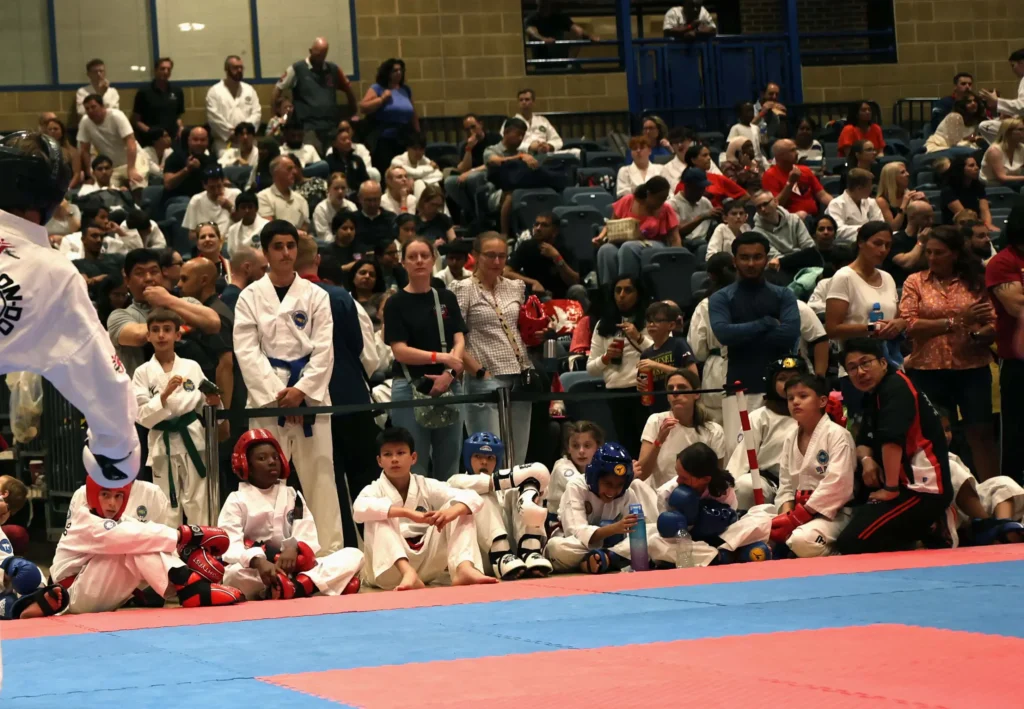
All timings are approximate and may change depending on the progress of the competition. Sportdata should be treated as the live source of information on the day.
Umpires, helpers and coaches should arrive from 8:30am.
The umpire and coach meetings are scheduled for 8:40am.
Black Belts should arrive from 8:45am.
The opening ceremony is scheduled for 8:55am.
Spectator doors open at 9:00am.
Competition begins for all Black Belts at 9:00am.
Check-in opens for all Pre-Cadets and Cadets at 9:00am.
Check-in closes for all Pre-Cadets and Cadets at 10:20am.
Pre-Cadet and Cadet competition begins at 10:30am.
Check-in opens for Adult and Veteran Colour Belts at 11:30am.
Check-in closes for Adult and Veteran Colour Belts at 11:55am.
Adult and Veteran Colour Belt competition begins at 12:00pm.
Check-in opens for Pre-Junior and Junior Colour Belts at 12:00pm.
Check-in closes for Pre-Junior and Junior Colour Belts at 12:25pm.
Pre-Junior and Junior Colour Belt competition begins at 12:30pm.
Umpire lunch breaks will begin from 2:00pm and will be staggered.
The competition is scheduled to finish at approximately 6:30pm.
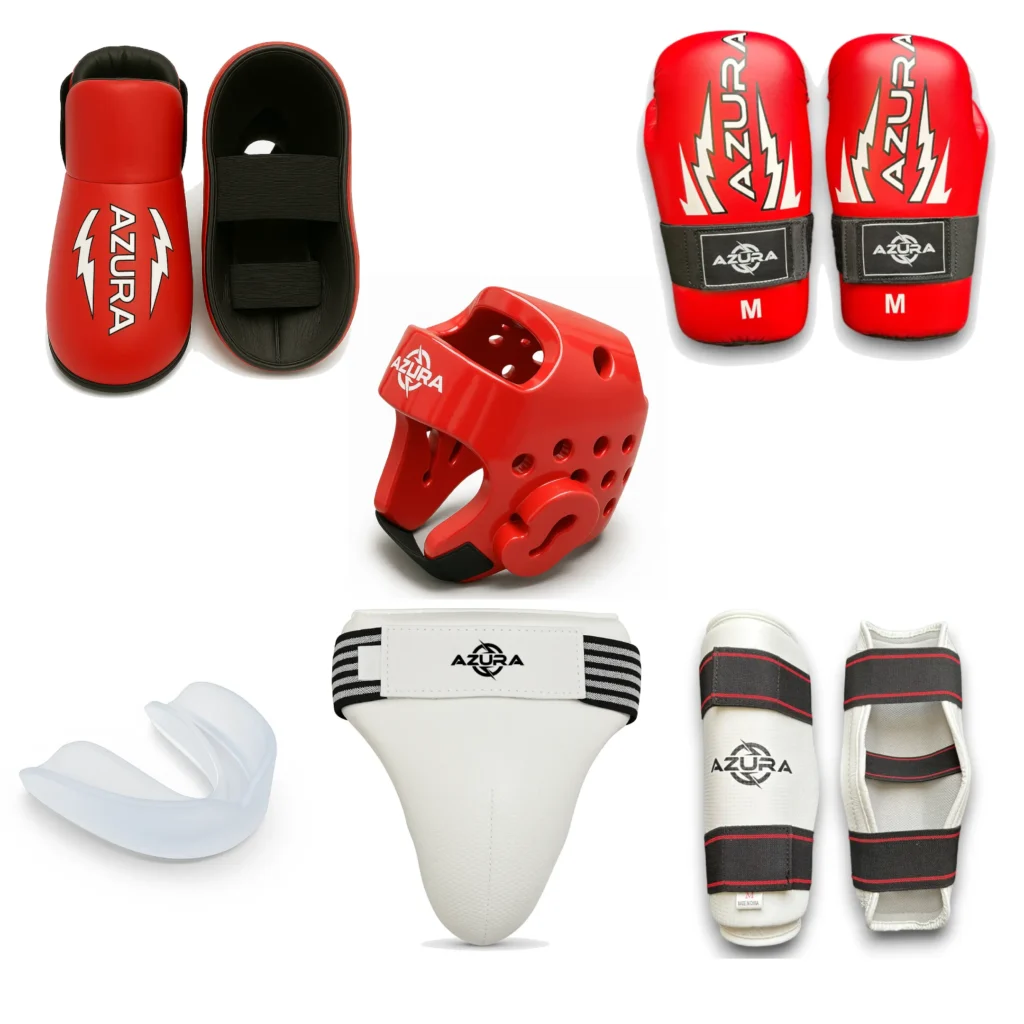
Please ensure you have the correct sparring equipment. Failure to have the correct equipment may lead to your disqualification if you are unable to get it on within 3 minutes.
Competitors must have:
Headguard
Semi-Contact Taekwon-Do Gloves (Open palm, not boxing gloves)
Semi-Contact Taekwon-Do Footpads
Transparent Mouthguard
Shinguards (Optional but highly recommended)
Groin Guard (Required for male competitors only)
Groin guards and shinguards must be under the competitors dobok.
We will be selling equipment on the day if you do not have the correct equipment, please speak to someone at the shop for assistance.
Scoring Area
Punches and kicks must land above the belt on the front or sides of the trunk or head.
Mid-section (trunk): front and sides above the belt
High section (head/neck): front and sides, not the back
Invalid areas: arms, shoulders, throat (unless head target), back of torso, groin, legs
Point Scoring System
| Technique | Target Area | Points |
|---|---|---|
| Punch | Trunk or Head | 1 |
| Kick | Trunk | 2 |
| Kick | Head | 3 |
Round details
Grade | Age Category | Number of Rounds | Round Duration
| Colour Belts | Cadet | 1 | 60 seconds |
| Colour Belts | Junior | 1 | 90 seconds |
| Colour Belts | Adult and Senior | 1 | 120 seconds |
| Black Belts | All | 2 | 120 seconds |
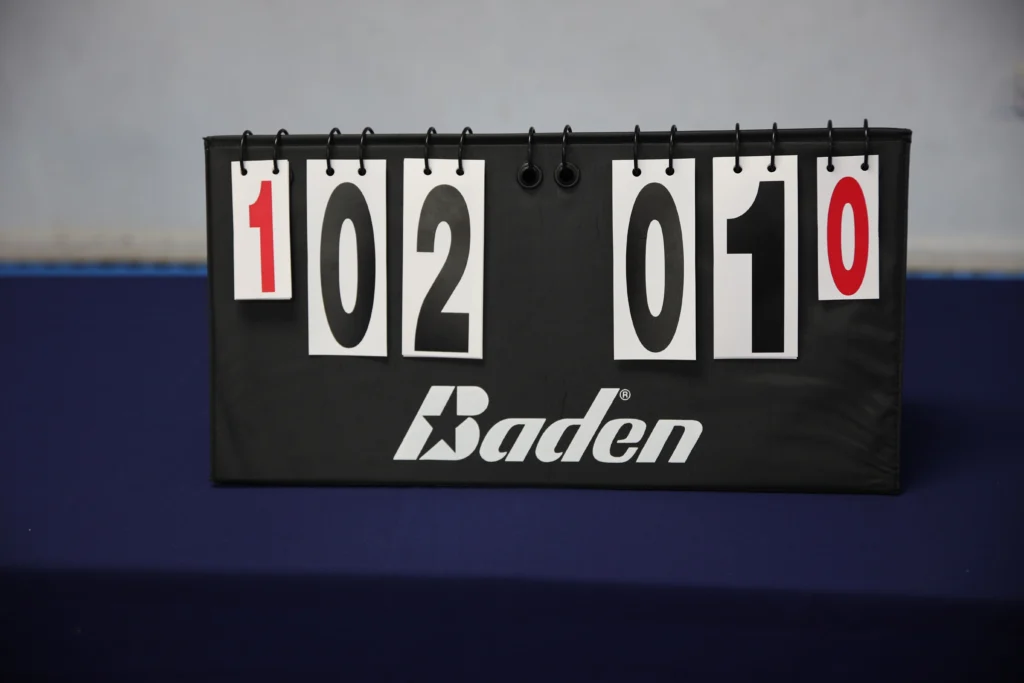
The scoreboard indicates warnings and fouls.
Black Numbers indicate warnings. 3 warnings are a minus point.
Red Numbers indicate fouls. Each takes one point off the competitor, and 3 equal instant disqualification.
Warning examples:
Attacking an illegal target area:
Below the beltIllegal techniques:
HeadbuttEach ring has 4 corner judges, a main referee, and a jury president.
Jury President
Sits at the main table overseeing the competition and ensuring it is done fairly. Oversees the timing, scorekeeping on the scoreboard, and paperwork/schedule. They handle protests from coaches.
Corner Judges
Corner judges are stationed at all 4 corners of the ring with a red and blue clicker. Each scored point will be added to their clicker. At the end of a contest they will review the points scored, deduct any minus points from the scoreboard, and vote using flags either red and blue following the count down from the Jury President.
Main Referee
The duty of a main referee is to ensure the safety and fairness of the competition. The are directly in the middle and will give commands in Korean to competitors such as Sijak (Start), Hecho (break, and commonly mistaken for “headshot”), and Goman (stop).
The referee will announce to the jury president any fouls, minus points, or decisions by speaking Korean, followed by the infringement in English.
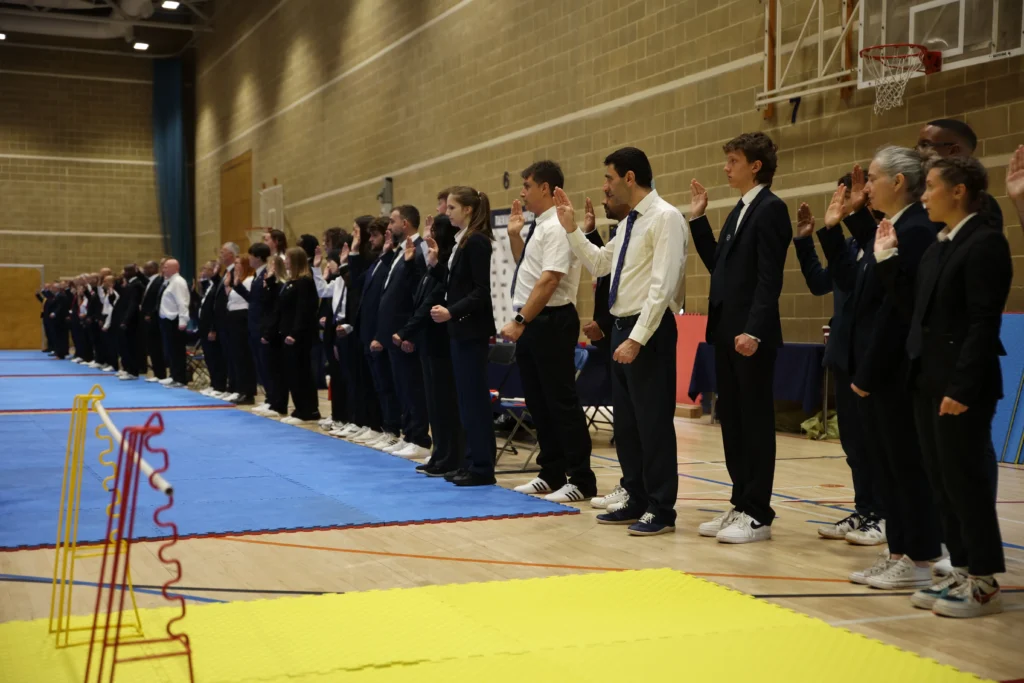
During patterns there will be 3-5 judges in a line in front of the jury president with a red and blue flag. Competitors will be called up and assigned a colour, red or blue, and sit on the red or blue mat depending on what they were assigned.
They will then be called into the ring, bow to the jury president and judges, and then each other. The jury president will call out what pattern to perform, such as: “optional pattern, Junbi (get ready), Sijak (start).
The competitors will then begin their patterns. After finishing their pattern they must exclaim their pattern name, such as “Do-San!” to let the judges know you have finished.
After the jury president will say “baro” (back to ready stand), and the Sywio (relax). The jury president will then instruct the 5 judges to announce the winner on a count. Each judge will raise a flag on who they thought did the pattern better. Judges can vote red/blue or tie. The winner will be the one with the most flags. In the event of a tie, the jury president will select a pattern to complete for the next round. This process is repeated until a winner is decided.
Umpires assess the performance based on technical correctness, power, balance, rhythm, sine wave, breath control and overall execution.
Minor mistakes reduce the score. Major mistakes, such as stopping for too long or performing the wrong pattern, may result in the pattern scoring zero.
After both competitors finish, each umpire votes for the competitor they scored higher. The competitor with the majority of umpire votes wins and progresses to the next round.
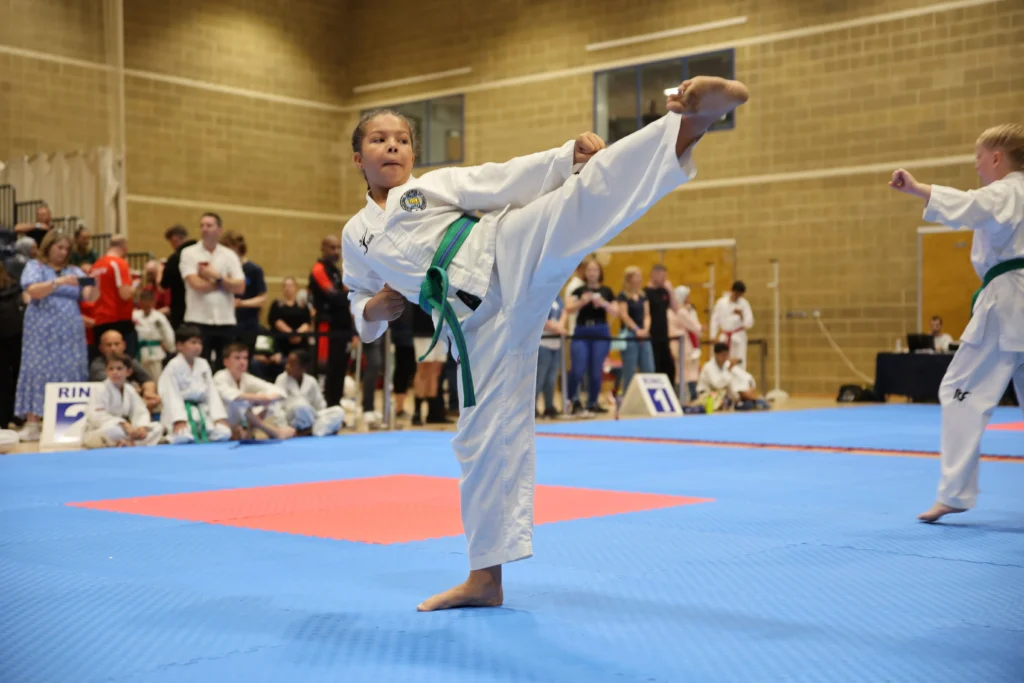
In Special Technique, competitors must perform each kick as a correct ITF Taekwon-Do technique. It is not enough to simply jump high and touch the target.
To score, the competitor must use the correct kick, hit the target with the correct part of the foot, show good posture, and land under control. If the kick does not look like the required technique, uses the wrong part of the foot, or the competitor falls after landing, or fails to do a guarding block after the tehcnique, the attempt may not score.
For Flying Side Kick, the competitor must jump over the hurdle, perform a proper side kick, hit the target, and land safely. If the hurdle is knocked over, no points are awarded for that attempt.
At the Impact Open, colour belts perform Flying Side Kick and Flying High Kick. Black belts perform all five ITF special techniques: Flying High Kick, Flying Turning Kick, Flying Reverse Turning Kick, Mid-Air Kick, and Flying Side Kick.
A strong, successful hit that fully moves the target back scores 3 points. A lighter touch scores 1 point. However, points are only awarded when the technique is legal and controlled.
In simple terms: the competitor must jump, perform the correct kick, hit the target properly, and land without falling. Special Technique rewards height, accuracy, balance, control, and correct Taekwon-Do technique.
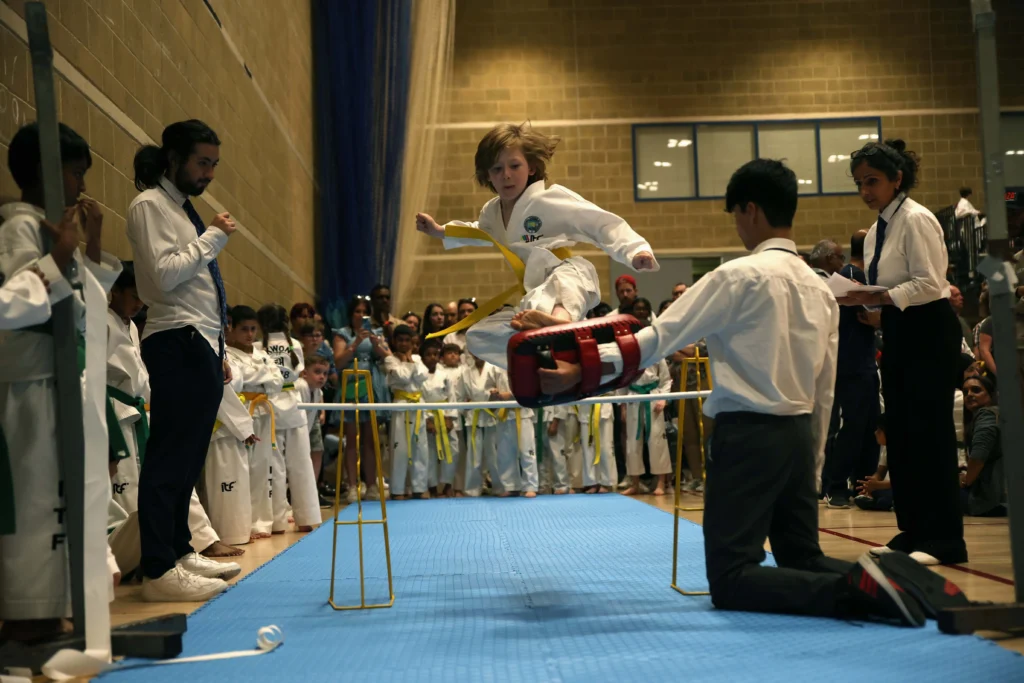
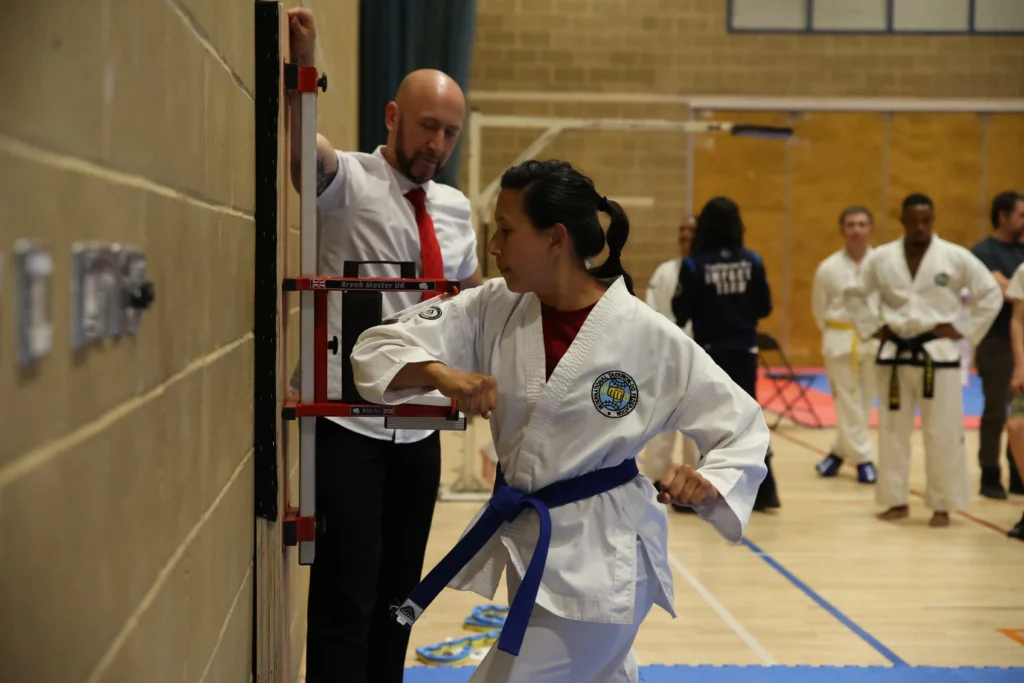
In Power Breaking, competitors try to break boards using correct ITF Taekwon-Do techniques. It is not just about strength, the technique must be accurate, controlled and performed with the correct part of the hand or foot and end in a guarding block.
To score, the competitor must perform the correct technique, use the correct attacking tool, and keep their balance. If the technique is incorrect, the wrong part of the hand or foot is used, or the competitor loses balance, or fails to finish in a guarding block, points may not be awarded.
Each board that is fully broken into two separate pieces scores 3 points. A board that bends or moves but does not fully break scores 1 point. If the board is not affected, or the technique is not legal, no points are awarded.
Colour belts choose one hand technique and one foot technique from the approved list, and they can choose how many boards they want to attempt. Black belts perform all five designated power techniques.
The total score from the competitor’s breaks is added together, and the three highest scores in the division win gold, silver and bronze. To receive a medal, a competitor must fully break at least one board.
In simple terms: the competitor must hit the board with the correct technique, break or bend it, and stay in control. Power Breaking rewards strength, accuracy, correct technique and balance.
| Grade | Gender | Hand Techniques | Foot Techniques |
|---|---|---|---|
| Colour Belt | Female | 1× Optional hand technique (elbow strikes allowed) | 1× Optional foot technique |
| Male | 1× Optional hand technique (elbow strikes NOT allowed) | 1× Optional foot technique | |
| Black Belt | Female | – 1× Forefist punch (1 board) – 1× Knifehand side strike (1 board) |
– 1× Side piercing kick (2 boards) – 1× Turning kick (1 board) – 1× Reverse turning kick (1 board) |
| Male | – 1× Forefist punch (2 boards) – 1× Knifehand side strike (2 boards) |
– 1× Side piercing kick (3 boards) – 1× Turning kick (2 boards) – 1× Reverse turning kick (2 boards) |